
Black Invisibility: Paul C. Taylor’s Framework in Nina and AHS: Coven
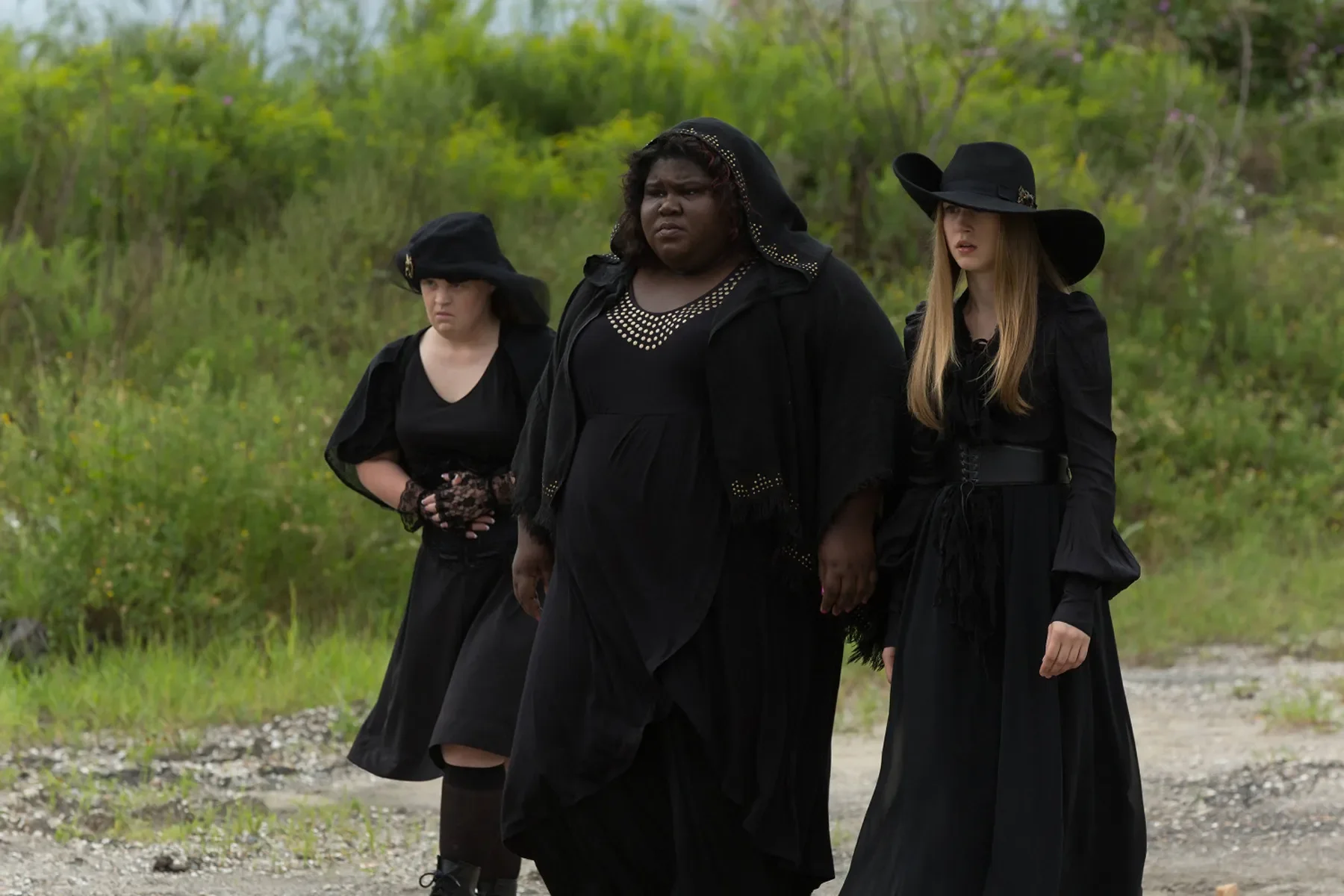
Questions of representation have long been central to the philosophy of art, but representation holds a unique and urgent weight for Black artists and subjects. Within a history defined by exile and stereotype, misrepresentation is never neutral: it reinforces systems of power. Philosopher Paul C. Taylor provides a theory of how one understands such dynamics through the concept of Black invisibility, a form of erasure that persists even when Black people appear on screen or within an artwork. Taylor holds that Black invisibility comes not only out of literal absences but out of the ways in which Black presence gets distorted, sidelined, or claimed by dominant white cultural narratives. As he explains, four types of erasure, presence, personhood, perspective, and plurality, show how Black identity is systematically constrained within the arts.
Taylor turns to Zoe Saldana’s casting as Nina Simone in the 2016 biopic Nina to show that miscasting is not simply a matter of poor aesthetic judgment but an ethical and political failure. When the body, voice, and life of a figure like Nina Simone, whose artistry cannot be separated from her Black womanhood, are reinterpreted through a lighter-skinned, narrower representation, then an entire history of Black struggle is flattened. To see how far-reaching these erasures are, American Horror Story: Coven is another good example. While the series seems progressive at face value because it weaves together themes of race, Black history, and witchcraft in its narrative, it ultimately reproduces all four of Taylor’s forms of erasure. Through its depiction of Voodoo Queen Marie Laveau, Queenie, and New Orleans itself, Coven participates in the same structures of invisibility that Taylor warns us about.

Paul C. Taylor, Author of Black Is Beautiful: A Philosophy of Black Aesthetics
By putting Taylor's argument in discussion with Nina and Coven, it is clear that Black invisibility is best understood not simply as absence, but rather as distortion of presence. Misrepresentation cannot be corrected through additive representation, through the inclusion of more Black characters or themes, but rather through a transformation of whose influence, perspective, and majority are allowed to shape cultural narratives. Media scholar Kristen J. Warner strengthens this point in her article “In the Time of Plastic Representation,” where she argues that Hollywood often casts Black actors in ways that appear progressive but are actually superficial, decontextualized, and culturally nonspecific. Warner’s concept of “plastic representation” directly supports Taylor’s argument: representation that lacks cultural specificity produces the illusion of diversity while perpetuating deeper forms of erasure. Consequently, this invisibility operates through four interconnected modes of erasure: presence, personhood, perspective, and plurality, each limiting the possibility for authentic Black self-representation.
Presence erasure refers to the literal or structural exclusion of Black artists, actors, or themes from the artworld. As Taylor points out, the white position remains the default; Black roles require justification, and even when stories about Black people exist, white actors replace them at times. Warner’s critique clarifies that tokenistic or surface-level inclusion can function as a more subtle form of exclusion, giving the impression that Black actors are present even when they are denied authentic or meaningful representation. A contemporary and widely recognized example of presence erasure can be seen in the backlash to Rue’s casting in The Hunger Games.
Personhood erasure is performed through the denial of full complexity, agency, and interiority to Black characters. The multidimensionality of Black characters is flattened into stereotypes or used for the plot development of white characters. These are objectifying aesthetic strategies that reduce Black identity and use Black characters as instruments for white plotlines. Taylor emphasizes how these representations deny Black characters the depth that is readily offered to white figures. Warner’s argument is again useful: plastic representation often gives Black characters screen time but not inner life, creating the appearance of diversity without any substantive engagement with their humanity. This is evident in shows such as Glee, where characters like Mercedes Jones are reduced to narrow stereotypes, the “diva,” the “sassy Black girl,” or the supportive background singer, while white characters receive richer emotional and narrative development.
Perspective erasure requires us to take into account the assumed audience of a work: Who is the story for? Whose perspective is being prioritized? Most of the films on race produced to date assume a white viewer, framing Black suffering as a spectacle or moral lesson rather than an experience with its own standpoint. In such cases, the narrative sympathies are directed toward white characters, reaffirming whiteness as the universal viewpoint. This is exemplified in The Blind Side, which centers the emotional growth and benevolence of the white Tuohy family rather than the interiority or agency of Michael Oher himself. Warner’s analysis helps explain why this remains common: when representation is treated as symbolic rather than lived, narratives default to familiar white vantage points rather than expanding to accommodate Black perspectives.
Finally, plurality erasure homogenizes Black identity, treating all Black experiences as interchangeable. Taylor refers to Lewis Gordon's argument that "to see that black is to see every black," which for him means that Black individuality often gets lost in representations that collapse distinctions of class, gender, ethnicity, and cultural background. This erases the nuance and diversity of Black life by reducing Black characters into mere symbolic representatives rather than individuals. All four forms of invisibility help clarify why misrepresentation is not a simple aesthetic error, but rather how structural racism continues through the arts. A clear contemporary example is the casting of Cynthia Erivo as Harriet Tubman in Harriet (2019). While Erivo is an extremely talented actress, she is British Nigerian, not African American, and Tubman’s identity is inseparable from the specific historical reality of enslaved Black Americans in the U.S. South. Warner’s notion of plastic representation makes the stakes clear: when casting relies on a generic idea of “Blackness,” cultural specificity is erased, and Black identities become interchangeable props rather than historically grounded subjects.
Perhaps the clearest example of Black invisibility in Taylor's work is the casting of Zoe Saldana as Nina Simone in Nina (2016). Though Simone was an iconically dark-skinned, broad-featured Black woman whose appearance helped shape her politics and her artistry, the filmmakers chose an actress whose phenotype is considerably different from Simone's. This choice, Taylor argues, embodies all four forms of erasure.
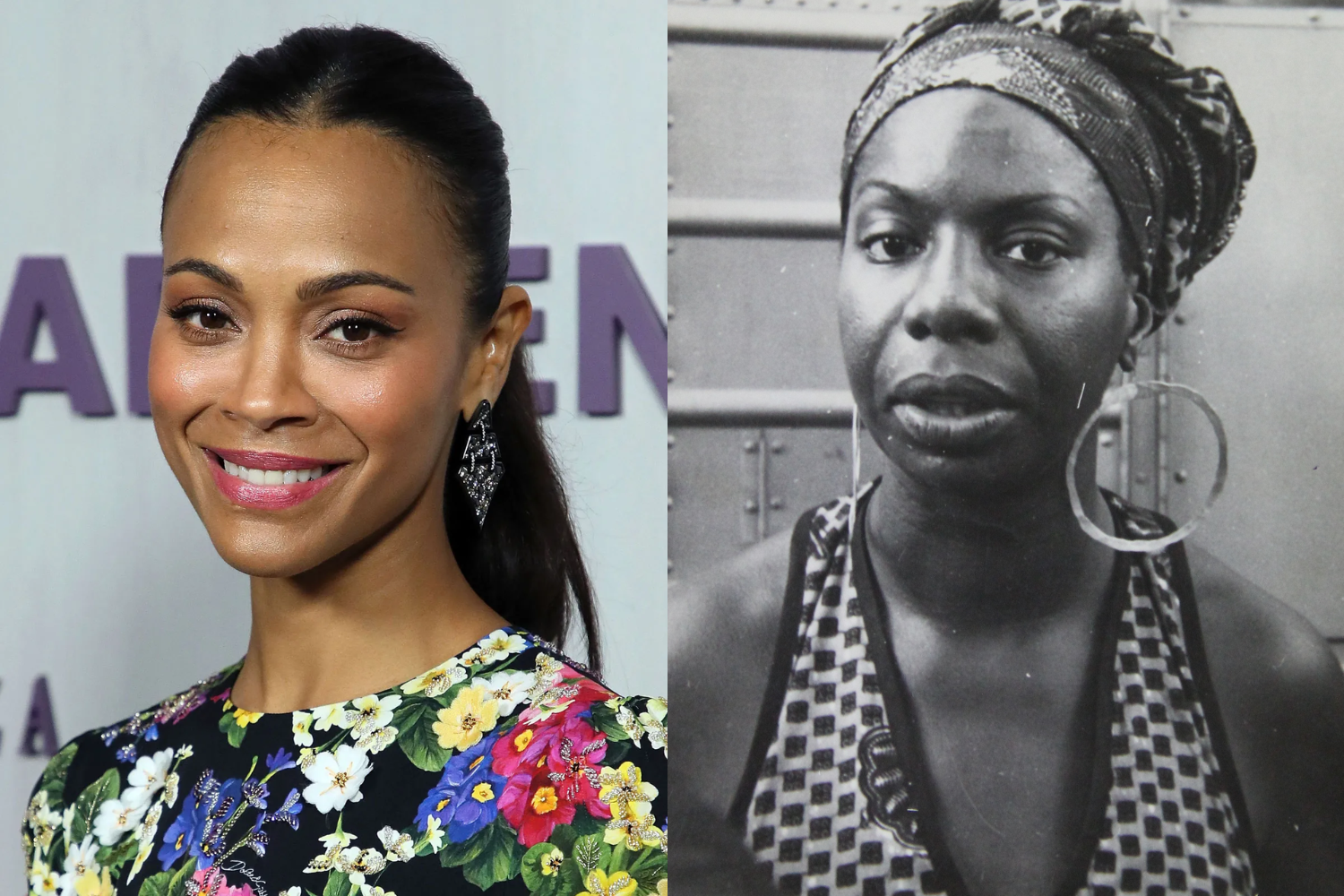
Zoe Saldana (left) and Nina Simone (right)
The presence erasure takes place because casting Saldana replaces an actress whose look and cultural background more closely resemble Simone's. In an industry where dark-skinned Black women are already fighting to get roles, this decision reproduces the very exclusion Taylor identifies in early Black cinema, reinforcing the notion that darker Black women are too unmarketable to play themselves.
Personhood erasure seems to appear in the use of prosthetics and dark makeup that the filmmakers employed to approximate Simone's features. Everything from her politics to her music dealt explicitly with the pride and pain of being a dark-skinned Black woman in America. What feels especially upsetting is how these prominent features are treated as a costume, again displacing agency and political subjectivity with aesthetic effect.
Perspective erasure surfaces when we consider the film's implied audience. The narrative seems tailored towards white viewers who would be more comfortable with a lighter-skinned actress softening Simone's radicalism and reframing her combativeness to something more palatable. This parallels Taylor's contention that whiteness tends to define the default viewer whose comfort shapes representation.
Finally, plurality erasure happens due to an assumption that any actress who identified as Black could stand in for Simone. Saldana, an Afro-Latina woman with cultural roots in the Dominican Republic and Puerto Rico, does not share the specifically Southern Black experience of Simone. By treating these distinct histories as interchangeable, the diversity of Black identities is collapsed into a singular category.
In combination, these four erasures of form explain the backlash: The film did not only miscast Nina Simone, it erased her.
Although American Horror Story: Coven advertises itself as a season deeply invested in Black history and Black magic traditions, its narrative ultimately reinforces all four forms of Black erasure as defined by Taylor: presence, personhood, and perspective.
It's a season set in New Orleans, a city whose cultural identity is deeply rooted in Black traditions, from music to spirituality and folklore. The narrative focuses largely on a white coven run by Fiona and Cordelia Goode. While Marie Laveau, a historical, powerful figure commonly referred to as the "Voodoo Queen", features in the show, she is placed in the role of secondary importance to the white witches from Miss Robichaux's Academy. The very construction of the show seems to say that the "true" magical hierarchy is white: the concept of the "Supreme" is a fictional, Eurocentric creation that supersedes the traditions of Laveau. While the show visually includes Black people, their cultural frameworks are not treated as a given; this, according to Taylor, is precisely what presence erasure does: Black histories show up but are never allowed to anchor the narrative world.
The most striking example of personhood erasure can be found in the portrayal of Queenie, whose power as a sort of “human voodoo doll” literalizes the reduction of her body to an instrument. Rather than granting her psychological depth or the same personal development as her white peers, Queenie becomes a symbolic spectacle whose pain is aestheticized for entertainment. Her abilities serve mostly white characters, and thus she aligns with what Taylor has described as “objectifying aesthetic strategies.”
Marie Laveau fares little better: despite the real historical figure's complexity, the show reduces her to a stereotype of the "vengeful Black woman." Her motivations are rarely explored beyond revenge, and her cultural authority is used mainly to heighten conflict rather than to explore her inner life or community context. In contrast, the white witches receive extensive emotional arcs, relationships, and individual growth. In both cases, the Black characters are not granted the kind of multidimensional personhood that Taylor says is essential in resisting erasure.
Coven uses Black suffering as a backdrop for white character development throughout. This is perhaps most egregious in the resurrection of Madame Delphine LaLaurie, a real-life historical torturer of enslaved Black people. Rather than centering the perspectives of her victims, the show frames her arc around her emotional reactions, her guilt, and her relationships with white characters. Scenes of racial violence and pain are narrated through a white lens, which aligns with Taylor's concept of perspective erasure, the assumption that the audience identifies with whiteness, and that whiteness is the narrative center. Moreover, despite the central themes of racism, Voodoo, and historical trauma, the show does not grant interpretive authority to Black characters. Their viewpoints are subordinated to the emotional journeys of white witches in a way that reinforces the very “whitely ways of seeing” that Taylor critiques.
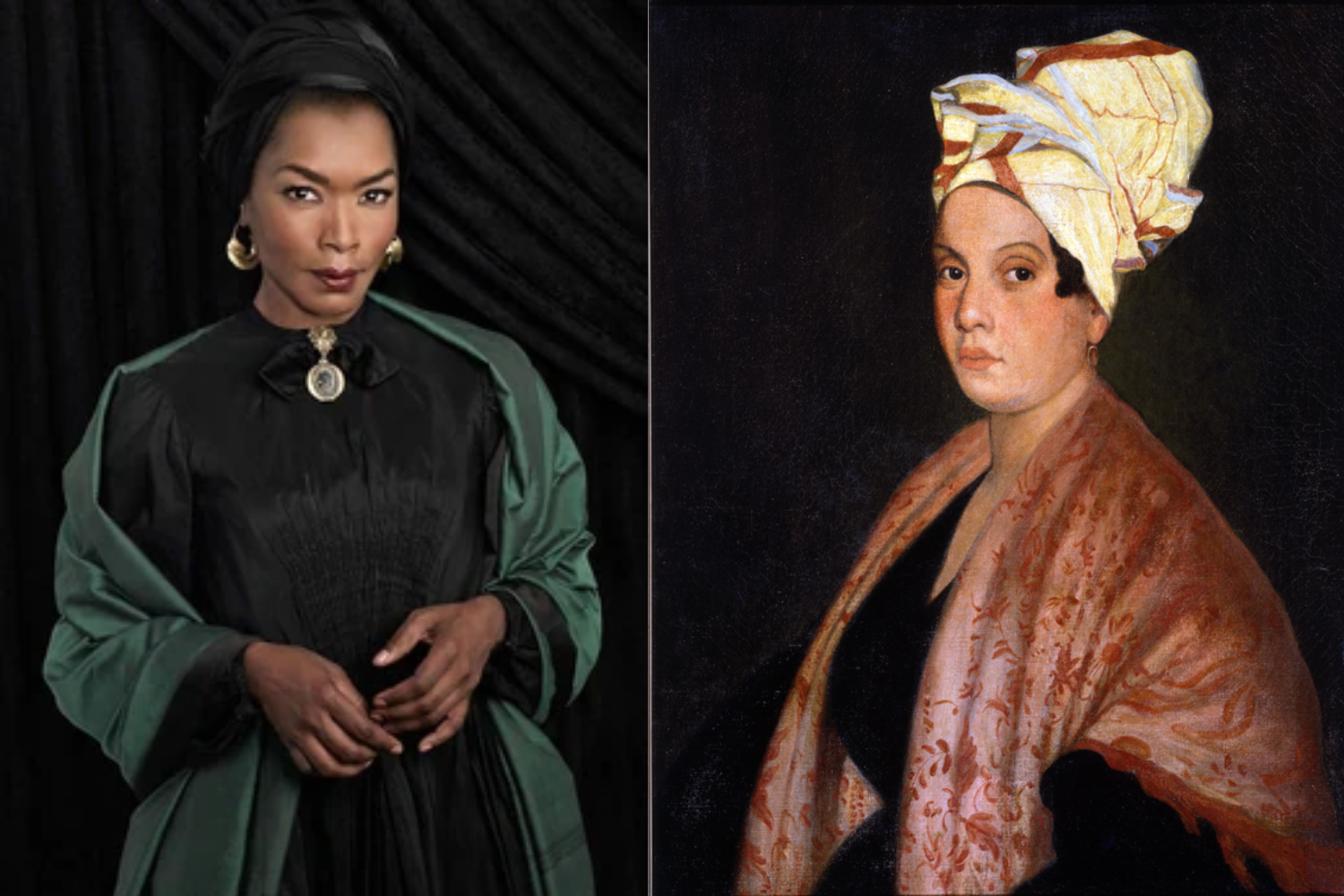
Angela Bassett as Marie Laveau (left) and painting of the real Marie Laveau (right)
Coven’s treatment of Marie Laveau further illustrates Taylor’s notion of plurality erasure by collapsing the specific cultural identity of a real historical figure into a generic symbol of Blackness. Angela Bassett’s powerful performance is inevitably shaped by the show’s refusal to engage with the Creole, Afro-Louisianan, and deeply localized cultural world that defined Laveau’s life and spiritual authority. Without locating her within the multilingual, multiracial heritage of 19th-century New Orleans, an identity that melted African, Indigenous, Caribbean, and French influences, the series positions her as an undifferentiated "Voodoo Queen," a shorthand that strips away the complexity of Creole cultural history. Bassett is tasked with playing Laveau not as a specifically Creole woman but as an archetype of "Black witchcraft," a role that could be played by virtually any Black actress because this character is detached from her ethnic, linguistic, and regional context. In flattening Laveau into a generalized figure rather than a culturally situated subject, Coven ultimately denies viewers access to the nuanced specificity of her identity and reproduces the very homogenization of Black experience that Taylor warns against.
The comparison between Nina and Coven reveals a consistent pattern that Black invisibility does not require the absence of Black characters. In fact, both works feature prominent Black roles. Yet, erasure persists through distorted presence, shallow depth, and narrative structures centered on whiteness. Taylor's framework thus presses beyond the assumption that representation itself is adequate. Instead, he forces us to investigate how Black subjects are represented, what cultural logics inform those representations, and whose frame of view directs the narrative.
Taken together, Taylor's work and cases like Nina and Coven demonstrate that the era of increased diversity on screen hasn't moved beyond Black invisibility. Without shifting the frameworks of presence, personhood, perspective, and plurality, Black characters risk remaining visible yet unseen.
Black invisibility is not only about who does and doesn't show up within a work of art, but also about how they show up, whose stories are centered, and whose identities are flattened or distorted. Taylor's four forms of erasure create a powerful lens for evaluating representation in today's media. The example of Zoe Saldana as Nina Simone makes clear that even well-intentioned casting can replicate racial hierarchies when the embodied identity and lived history of its subject are ignored. American Horror Story: Coven serves equally to show that surface-level inclusion does not ensure meaningful representation; ultimately, white narratives drive the action, Black depth gets marginalized, and Black cultural traditions are used, but not allowed to define the story.
Put together, these works confirm Taylor's central insight: Black invisibility persists through the very systems claiming to counteract it. Authentic representation requires more than presence: a transformation in who is allowed to shape narratives, whose identities are recognized in their fullness, and whose perspectives become central rather than peripheral. Only then can the arts begin to undo the long history of erasure that Taylor so forcefully critiques.
Works cited:
Taylor, Paul C. Black Is Beautiful: A Philosophy of Black Aesthetics. Wiley-Blackwell, 2016.
Warner, Kristen J. “In the Time of Plastic Representation.” Film Quarterly, vol. 71, no. 2, Winter 2017.
